

Voice AI
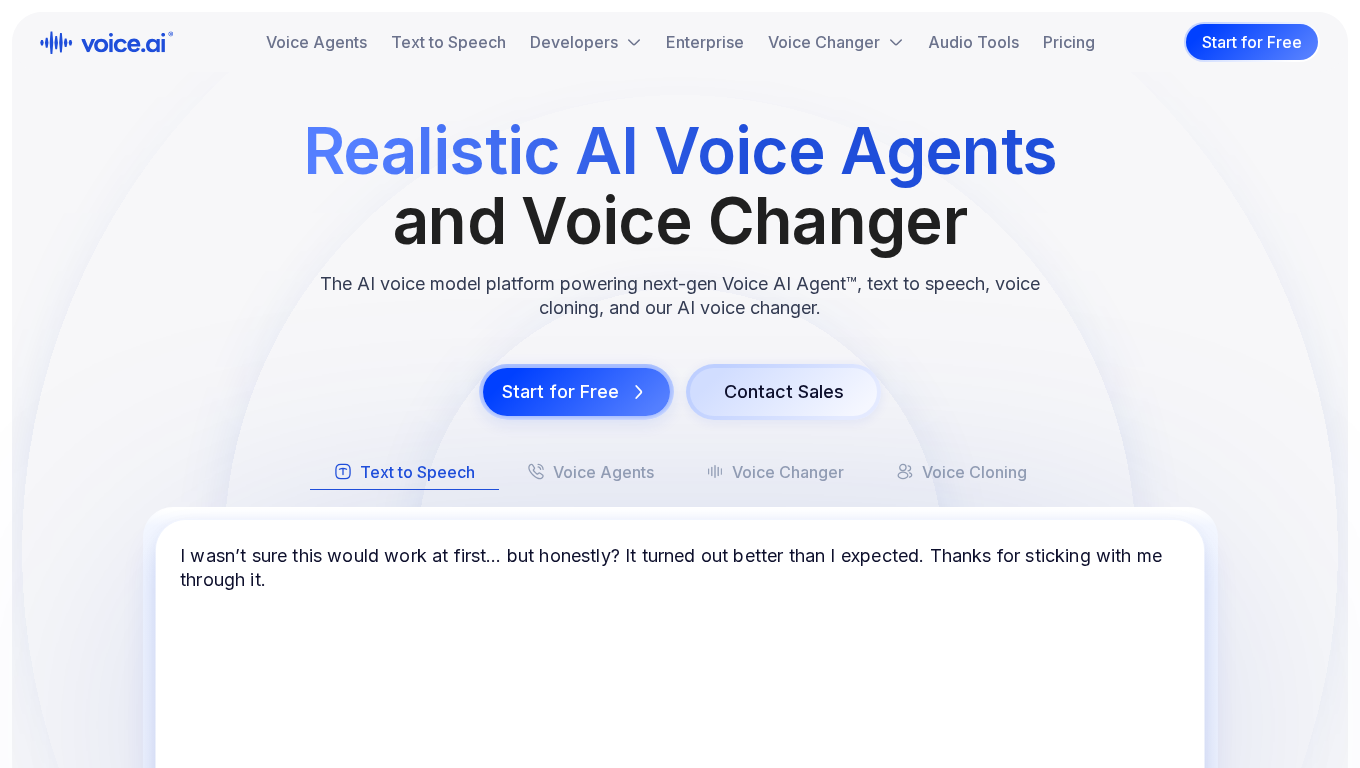
Voice.ai is a voice AI platform offering real-time voice processing, voice cloning, and speech synthesis capabilities for developers and businesses. The platform is positioned between a raw API provider and a turnkey application — it gives developers the building blocks to embed voice AI into their own products while also offering ready-made solutions for common use cases. Whether you are building a voice agent, adding voice cloning to a content pipeline, or creating real-time speech-to-speech applications, Voice.ai provides the infrastructure layer.
Disclosure
AI Velocity Lab may receive an affiliate commission when you sign up for Voice.ai through links on this page. This does not affect our editorial review process. We only recommend tools we have verified deliver real value for the use cases described.
Velocity Highlights
- Build real-time voice AI applications with low-latency speech-to-speech processing
- Clone any voice from a short audio sample for use across applications
- Access high-quality neural voice synthesis in 40+ languages
- Design entirely new synthetic voices from scratch using the Voice Design tools
- Integrate via API, SDK, or pre-built components depending on implementation depth
Pricing
Subject to change — verify current pricing on the vendor site.
| Plan | Price (monthly) |
|---|---|
| Free | $0 |
| Starter | ~$15-25 |
| Pro | ~$50-100 |
| Enterprise | Custom |
Use cases
- Voice Agent Development
- Content Production Voice-Over
- Real-Time Translation and Dubbing
- Accessibility Applications
Key features
- Real-Time Voice AI
- Voice Cloning
- Voice Design
- Text-to-Speech Synthesis
- Multi-Language Support
Pros & cons
Pros
- Full voice AI stack in one platform — synthesis, cloning, real-time processing
- Developer-friendly API with SDKs for common frameworks and languages
- Voice Design feature allows creating entirely new synthetic voices without cloning a real speaker
- Supports 40+ languages for global application deployment
- Flexible tiered pricing scales from small projects to enterprise volume
Cons
- Documentation and onboarding can be uneven across different feature areas
- Credit system requires careful monitoring to avoid unexpected overage charges
- Real-time conversational AI requires significant integration work — not a plug-and-play solution
- Voice quality varies across the library — some voices are significantly more natural than others
- Enterprise pricing is opaque — requires sales contact for custom quotes
FAQ
Do I need to be a developer to use Voice.ai?
Not exclusively — the web interface supports basic text-to-speech synthesis and voice cloning without coding. However, the platform’s full capability is accessed through the API, and features like real-time conversational AI require developer integration work. Non-technical users will find the core synthesis features accessible; advanced features are developer-facing.
How long does voice cloning take?
Voice cloning on Voice.ai typically requires a short audio sample — the exact minimum length depends on the voice and quality requirements. In general, the more clear audio you provide (ideally 30+ minutes of clean recording), the more accurate the clone. Some use cases may work with much shorter samples — test with your specific audio source.
Can I use any voice for commercial projects?
Commercial use rights depend on the plan tier and the voice source. Standard voice library voices are covered for commercial use on paid plans. Cloned voices require that you have the rights to clone the source speaker — using a cloned celebrity voice without consent is not permitted. Review Voice.ai’s terms of service for specific commercial licensing details.
What is the latency for real-time applications?
Voice.ai optimizes for low-latency real-time processing, though exact latency depends on network conditions, audio input quality, and the specific model being used. For typical applications, expect latency in the range of a few hundred milliseconds to low seconds. Applications with strict real-time requirements should test in their specific environment before full deployment.
How does Voice Design differ from voice cloning?
Voice cloning replicates an existing real speaker’s voice from audio samples. Voice Design constructs a synthetic voice from scratch by specifying characteristics — age, gender, accent, tone — without requiring an existing recording of the target voice. Voice Design is useful when you need a consistent synthetic voice that does not depend on any real individual.
Final verdict
Voice.ai is a capable voice AI platform that covers the full stack from real-time processing to synthesis and cloning. It is most directly differentiated from ElevenLabs by its real-time capabilities and its Voice Design feature, while Resemble AI is more narrowly focused on voice cloning. For developers building voice AI into products, Voice.ai provides the infrastructure without requiring a full platform commitment. The credit system rewards consistent usage planning, and the tiered plans scale reasonably from small projects to enterprise volume.